
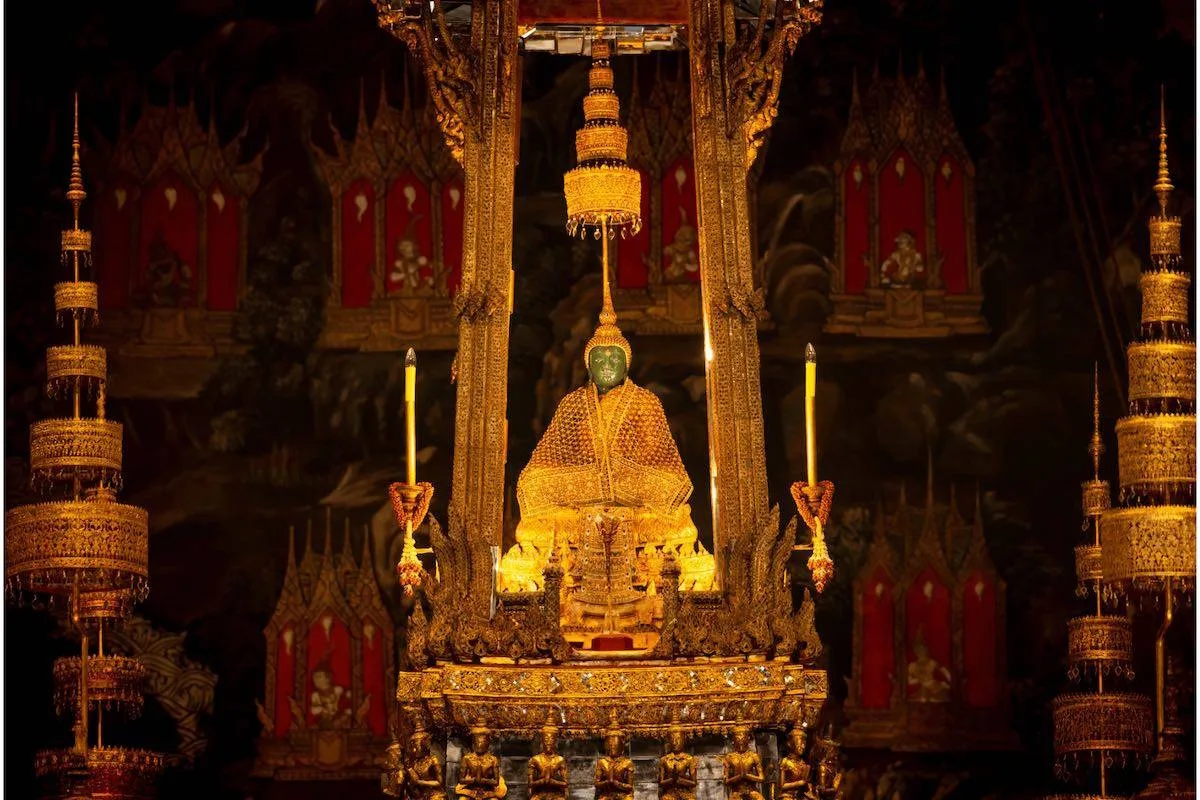
 At Wat Phra Kaew, the Emerald Buddha, dressed in golden attire, sits enthroned beneath a tiered parasol, framed by candles and gilded ceremonial parasols; praying figures adorn the base, before red and gold mural paintings.© Internet
Buddhist temple
Wat Phra Kaew
A royal chapel raised between 1782 and 1785 within the precincts of the Grand Palace, Wat Phra Kaew houses the Emerald Buddha, an image that came from the north, whose possession accompanied the founding of Bangkok and which the king still dresses with his own hands as the seasons turn.
Heritage family · Buddhism, religions and spiritualities
- Destination
- Bangkok (Phra Nakhon)
- Heritage Family
- Buddhism, religions and spiritualities
- Typology
- Buddhist temple
- Visit
- Available tours →
Wat Phra Kaew is the royal temple of the Grand Palace in Bangkok, built to house the Emerald Buddha. It is often regarded as the most important temple in Thailand. It is not a monastery, but the former private chapel of the kings and their court. General Chakri, who became king under the name Rama I, founded it at the same time as his new capital. There he installed a statue that had passed from kingdom to kingdom and that other sovereigns had kept before him. Around the ubosot that houses it are gathered chedis, dynastic shrines and a long gallery painted with the Ramakien. The king still presides over seasonal rites there.2
Key facts
- Destination
- Bangkok
- Heritage Family
- Buddhism, religions and spiritualities
- Typology
- Buddhist temple
- Places
- The Grand Palace of Bangkok
- Rattanakosin Island
- Phra Nakhon
- Periods
- People
- Maha Vajiralongkorn
- Rama Ier
- Rama III
- Rama IV (Mongkut)
- Taksin
- Communities
- —
- Events
- Founding of Bangkok (1782)
- Foundation of the Grand Palace
- Foundation
- Restoration under Rama III
- Restoration under Rama IV
- Emerald Buddha at Wat Chaeng
- Heritage
- Seasonal change of the Emerald Buddha's attire
- Emerald Buddha
- Glossary
- Wat
- Buddha image
- Rai
- Chedi
- Reliquary
- Ubosot
- Keywords
- —
- Date
- —
- Collections
- —
Practical info
Practical information about this site is taken from its Google Maps page. We advise you to check it before visiting.
- Address
- Na Phra Lan Rd, Khwaeng Phra Borom Maha Ratchawang, Khet Phra Nakhon, Krung Thep Maha Nakhon 10200
- Website
A sanctuary at the heart of royal power
A royal chapel without a monastic community
Wat Phra Kaew occupies the north-eastern corner of the Grand Palace, on Rattanakosin Island in Bangkok. It is not a single, isolated building but a group of buildings, brought together within one enclosure and arranged around a single image, the Emerald Buddha. It is this statue that gives the place its common name.4
Yet Wat Phra Kaew is not a monastery in the usual sense. No monks or nuns live there, and it is not their principal place of assembly. It was formerly the private chapel of the kings and the court.2
An official name and its namesakes
The temple’s official name is Wat Phra Si Rattana Satsadaram; Wat Phra Kaew is merely a shortened form that has passed into common use. The same name is borne by other temples in the country, in Chiang Rai, Kamphaeng Phet and Phetchaburi, which should not be confused with the Bangkok sanctuary. One of them, in Chiang Rai, is bound up with the very history of the image.4
The Emerald Buddha also has two Thai names: Phra Kaeo Morakot in everyday use, and Phra Phuttha Maha Mani Rattana Patimakon as its ceremonial name. Despite its name, it contains no emerald. The statue owes this name to its green colour, that of a hard stone whose exact nature is still debated.10
The long journey of the Emerald Buddha
An image of unknown origin
The Emerald Buddha is an image of the Buddha seated in meditation, of modest size. Where, when and by whom it was carved is unknown. Even its material divides specialists: jade and jasper have been suggested, and one hypothesis sees it instead as a jadeite from northern Thailand or from the Shan State, in present-day Myanmar.3
The question of where it was made remains open. Some scholars, drawing on the doctoral thesis of the art historian Melody Rod-ari, place its creation in the region of Chiang Rai and Chiang Saen, in the far north of the country. This hypothesis would link the image to the kingdom in which it first appears, but nothing allows it to be taken as established.13
From Chiang Rai to Lampang
The image enters history in 1434, in the kingdom of Lan Na. In Chiang Rai, lightning strikes a chedi, a reliquary monument, at Wat Pa Yia, and reveals a statue covered in stucco. The abbot removes this coating and discovers a figure carved from a green semi-precious stone. The temple then takes the name Wat Phra Kaew. A legend adds that the image is said to have been carried off in 1432, then hidden in Chiang Rai before its discovery.14
In 1436 King Samfangkaen, then ruling Lan Na, has the image brought to his capital, Chiang Mai. According to tradition, the elephant carrying it refuses this route and of its own accord takes the road to Lampang. This is received as a divine sign: the image remains in Lampang, in a temple built for it, the present-day Wat Phra Kaeo Don Tao. It stays there for some thirty years.3
From Vientiane to Thonburi
King Setthathirath, ruler of Lan Xang, the neighbouring Lao kingdom, later seizes the image and makes it his personal palladium, that is, the sacred object that protects his person and his power. The statue then resides in Vientiane.10
It is in Vientiane that, at the end of the 18th century, it is recovered by General Chakri, then in the service of King Taksin, who reigns from Thonburi. Taksin keeps the image for about five years, from 1779 to 1784, at Wat Jaeng, the present-day Wat Arun. Over three and a half centuries, the Emerald Buddha thus passed from Lan Na to Lan Xang and then to the Siamese kingdom.1
A capital founded around an image
Rama I and the founding of the temple
After Taksin is deposed, General Chakri becomes king under the name Rama I and founds a new dynasty. He establishes his capital, Krung Rattanakosin, today Bangkok. There he has the Grand Palace built and, within its precincts, Wat Phra Si Rattana Satsadaram, where he installs the Emerald Buddha.1
This transfer is not simply the moving of an object. By installing the image within the precincts of his palace, Rama I marks the beginning of his reign. Temple, palace and capital are born together. The king also links the place to the memory of his family: he has two gilded chedis raised there in memory of his parents.2
The stages of the founding
Work begins in 1782 and is completed in 1783. The consecration takes place in 1785, with the solemn transfer of the image into the ubosot, the ordination hall, at the beginning of that year. These stages span the very first years of the reign of Rama I, when the temple rises at the same time as the capital.10
The restorations of Rama III and Rama IV
Half a century after the founding, King Rama III has the whole complex restored to mark the fiftieth anniversary of the Chakri dynasty. Most of the murals visible today date from his reign.2
At the end of the reign of Rama IV, a further restoration is accompanied by the construction of additional shrines. The Ho Phra Ghandharat pavilion is then raised at the front corner of the ubosot’s cloister.12
Reading the monumental complex
The ubosot and the image’s throne
The heart of Wat Phra Kaew is the Phra Ubosot, the ordination hall that houses the Emerald Buddha. The image does not rest on a simple altar: it is set high up, beneath a busabok, a gilded pavilion topped by a spire, in the form of a prasat, a building with a tiered roof, here of five levels.2
It is up to this busabok that the king climbs, several times a year, to change its regalia.6
The northern platform and dynastic memory
To the north of the ubosot, a raised platform lines up several major buildings from west to east. The Phra Si Rattana Chedi, the largest chedi in the temple, opens the sequence. Next comes the Phra Mondop, a square pavilion whose northern stairway is guarded by sculptures of demons. The Prasat Phra Thep Bidon houses statues of the kings of the Rattanakosin period. The two gilded chedis raised by Rama I for his parents complete this alignment.4
This platform thus brings together Buddhist veneration and the cult of the royal line. Other monuments within the precincts are dedicated to former Chakri kings, and the Phra Wihan Yot adds to the complex’s shrines. The temple also includes several pavilions and a belfry whose bell rings only on rare occasions, such as the announcement of a new Supreme Patriarch, head of the country’s monastic community.4
The Ramakien gallery
The cloister surrounding the complex is covered with murals devoted to the Ramakien, the Thai version of the Ramayana, the Indian epic of Prince Rama. The cycle unfolds in 178 sections. It begins near the front of the Phra Wihan Yot and runs right round the cloister, so that visitors follow the epic as they walk.5
These paintings date back to the reign of Rama I, but they have been restored and repainted on several occasions. Those of the Rama III period largely follow the style and themes of the first campaign, which explains why much of the present painting belongs to that reign without breaking with the original programme. The gallery is today among the main points of interest for visitors, and the whole is regarded as a major testimony to Thai craftsmanship since the late 18th century.5
Royal rites and religious life
The seasonal regalia of the Emerald Buddha
The most visible rite at Wat Phra Kaew is the changing of the Emerald Buddha’s regalia, performed three times a year, at the turn of the hot season, the rainy season and the cool season. The ceremony, a royal rite, is presided over by the king in person.6
The ceremony follows a precise order. The king climbs up to the busabok, removes the crown of the season that is ending, purifies the image with lustral water, a consecrated water, and then places the new crown. Brahmins, officiants of the royal rites of Hindu origin, conclude the ceremony with the Wien Thien, a circumambulation, a procession around the sanctuary, by candlelight. The king then sprinkles holy water over the officials and the public gathered outside. Today King Maha Vajiralongkorn (Rama X) performs this rite with Queen Suthida, as in July 2026.6
Rain, ploughing and oaths
Other royal ceremonies long centred on a second image, the Phra Ghandharat, also called Phra Kho Fon, the ‘Buddha who asks for rain’. Kept in the Ho Phra Ghandharat pavilion built under Rama IV, this statue was the principal image of the royal rain ceremony and of the Royal Ploughing Ceremony, which opens the agricultural season. This practice is traced back to the reign of Rama I.12
Finally, the Emerald Buddha is a solemn witness. According to a traditional practice, politicians accused of corruption come to swear their innocence before the image.3
Wat Phra Kaew today
A royal place of worship open to the public
Wat Phra Kaew remains an active royal place of worship, where the seasonal rites continue to be celebrated. It comes under the Bureau of the Royal Household, which also manages the Grand Palace. A single ticket gives access to the palace, the temple and the Queen Sirikit Museum of Textiles; the site is open every day, and admission is free for Thais on presentation of their identity card.11
This dual role as royal sanctuary and visited monument shapes the experience of the place. Visitor numbers fell sharply when mass tourism came to a halt, around 2020. The courtyards and the gallery then regained an unaccustomed calm.4
A memory shared beyond Bangkok
The image’s journey has left its mark on the cities that received it. In Chiang Rai, where the statue had appeared in 1434, a replica of the Emerald Buddha was consecrated in 1991 at the city’s Wat Phra Kaew. In Lampang, Wat Phra Kaeo Don Tao recalls the years when the image was kept there.13
These places make the Emerald Buddha a figure shared by several regions and several former kingdoms. Wat Phra Kaew in Bangkok is its point of arrival and its royal sanctuary; but the story it holds begins elsewhere, in the north, and is also told through the temples that preserve the memory of its passing.
Understanding
Wat Phra Kaew is neither a monastery nor a mere monument: it is the sanctuary that the kings of Bangkok built within their own palace to keep an image that came from elsewhere. Its importance lies in that bond. The Emerald Buddha, having passed from Lan Na to Lan Xang and then to Siam, was installed at the centre of a new capital, surrounded by chedis, dynastic shrines and a painted epic, and the king continues to dress it with his own hands in step with the seasons. The place thus unites Buddhist devotion, royal memory and court art. Today it lives under two regimes at once: a royal chapel where the rites continue, and a monument open to the public, whose visitor numbers fell sharply when mass tourism stopped. A replica and temples in the north are reminders that the image’s story extends beyond Bangkok. Will Wat Phra Kaew remain first and foremost the sanctuary of a monarchy, or will it become, above all, for those who walk through it, the monument to a history shared by several kingdoms?
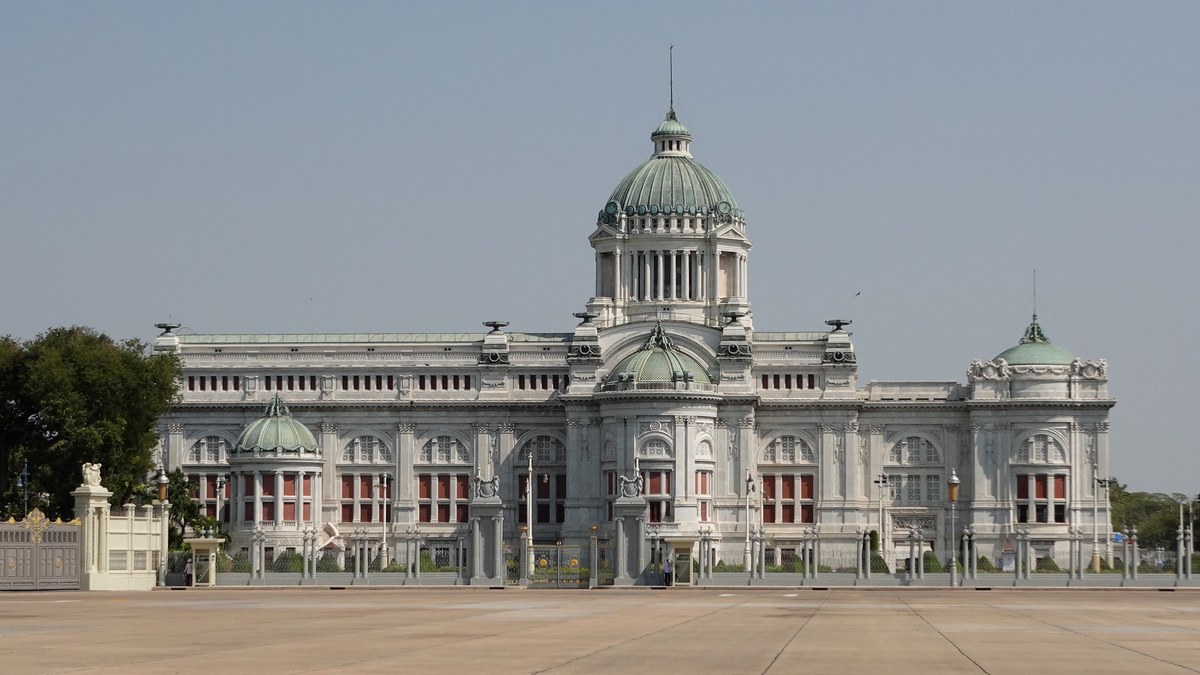
Rattanakosin, from the royal citadel of 1782 to the historic districts that shaped contemporary Bangkok.
- Wat
- Buddhist monastic complex that brings together, within a single enclosure, several religious buildings, monks’ quarters and ancillary buildings; the word does not refer to a single building.
- Buddha image
- In Thai Buddhism, a devotional representation of the Buddha, most often a statue, venerated as an object of worship.
- Rai
- Thai unit of land area, equivalent to 1,600 square metres.
- Chedi
- A bell-shaped reliquary monument, the Thai version of the Indian stupa.
- Reliquary
- A container intended to hold and protect one or more relics.
- Ubosot
- Consecrated ordination hall of a wat: the ritually central building, marked out by sacred boundary stones, where monastic ordinations take place.
- Ordination
- Ceremony by which a layperson is admitted as a novice or as a monk into the Buddhist community.
- Busabok
- Thai throne in the form of a small pavilion, covered by a tapering spired roof.
- Prasat
- In Thai architecture, a building or canopy with tiered roofs crowned by a spire, a form reserved for sacred images and for royalty.
- Tiered roof
- Roof made up of several superimposed, stepped sections, characteristic of traditional religious and royal architecture in Thailand.
- Mondop
- Small sacred building or pavilion, often square in plan, which may house a sacred image, a Buddha footprint, relics, scriptures, ashes or another sacred object.
- Rattanakosin period
- Period of Thai history that began with the founding of Bangkok as the capital by King Rama I at the end of the eighteenth century. It takes its name from Rattanakosin Island, the heart of the royal city.
- Ramakien
- Thai version of the Ramayana, the Indian epic of the hero Rama.
- Ramayana
- Great Sanskrit epic of India recounting Prince Rama’s struggle against the king of the demons; it has inspired many versions in Southeast Asia, including the Thai Ramakien.
- Principal image
- In a Thai Buddhist monastery, the most important statue of the Buddha, around which worship is organised; it is generally installed in the monastery’s main building.
- Royal temple
- In Thailand, a Buddhist temple founded, restored or patronised by the king or the royal family, and graded according to an official hierarchy of ranks and categories.
- Supreme Patriarch
- Head of the Buddhist monastic community of Thailand, appointed by the king.
- Sangha
- The body of monks who reside in a monastery and live there according to religious discipline; in Buddhism it is called the sangha.
- Royal Ploughing Ceremony
- Thai royal ceremony of Brahmanical origin, held each year to open the agricultural season and foretell the harvest, combined with Buddhist rites.
- Brahmin
- In Thailand, an officiant heir to the Hindu tradition, attached to the court, who conducts or assists royal rites of Brahmanical origin alongside the Buddhist clergy.
- Wien Thien
- Thai rite of circumambulation: a procession around a sanctuary or venerated object, holding candles, incense and flowers, keeping it on one’s right.
Primary sources
- 1Thailand National Committee on the World Heritage Convention, Phra Prang of Wat Arun Ratchawararam: The Masterpiece of Krung Rattanakosin, World Heritage Tentative Lists — ref. 6821 (State Party: Thailand), UNESCO World Heritage Centre, 2025-04-09 ↗
Studies
- 2Wat Phra Kaew (Temple of the Emerald Buddha), Smarthistory ↗
- 3The Temple of the Emerald Buddha, World History Encyclopedia ↗
- 4Far from the madding crowds, Bangkok Post, 2020 ↗
- 5Wat Phra Kaew’s Ramakien murals: A masterpiece wrapped around Bangkok’s sacred temple, Khaosod English, 2026 ↗
- 6Their Majesties the King and Queen Preside Over Seasonal Robe-Changing Ceremony for the Emerald Buddha, The Nation (Thailand), 2026 ↗
- 7HM the King Changes Emerald Buddha’s Attire, Pattaya Mail, 2019 ↗
- 8The Nation/ANN, Thai King takes part in ritual to change Emerald Buddha’s outfit, The Star, 2024 ↗
- 9King changes Emerald Buddha's attire, The Nation (Thailand), 2018 ↗
Reference works
- 10Emerald Buddha, Wikipedia ↗
- 11Practical Information, Bureau of the Royal Household (The Grand Palace) ↗
- 12Phra Ghandharat, Wikipedia ↗
- 13The Emerald Buddha: Legend, Myth, and the Bedazzlement of History and Nation-Creation, University of Washington Libraries ↗
- 14Wat Phra Kaew, Chiang Rai, Wikipedia ↗
- 15Temple of the Emerald Buddha | History & Location, Study.com ↗
Further reading
Contemporary views
Wat Phra Kaew today
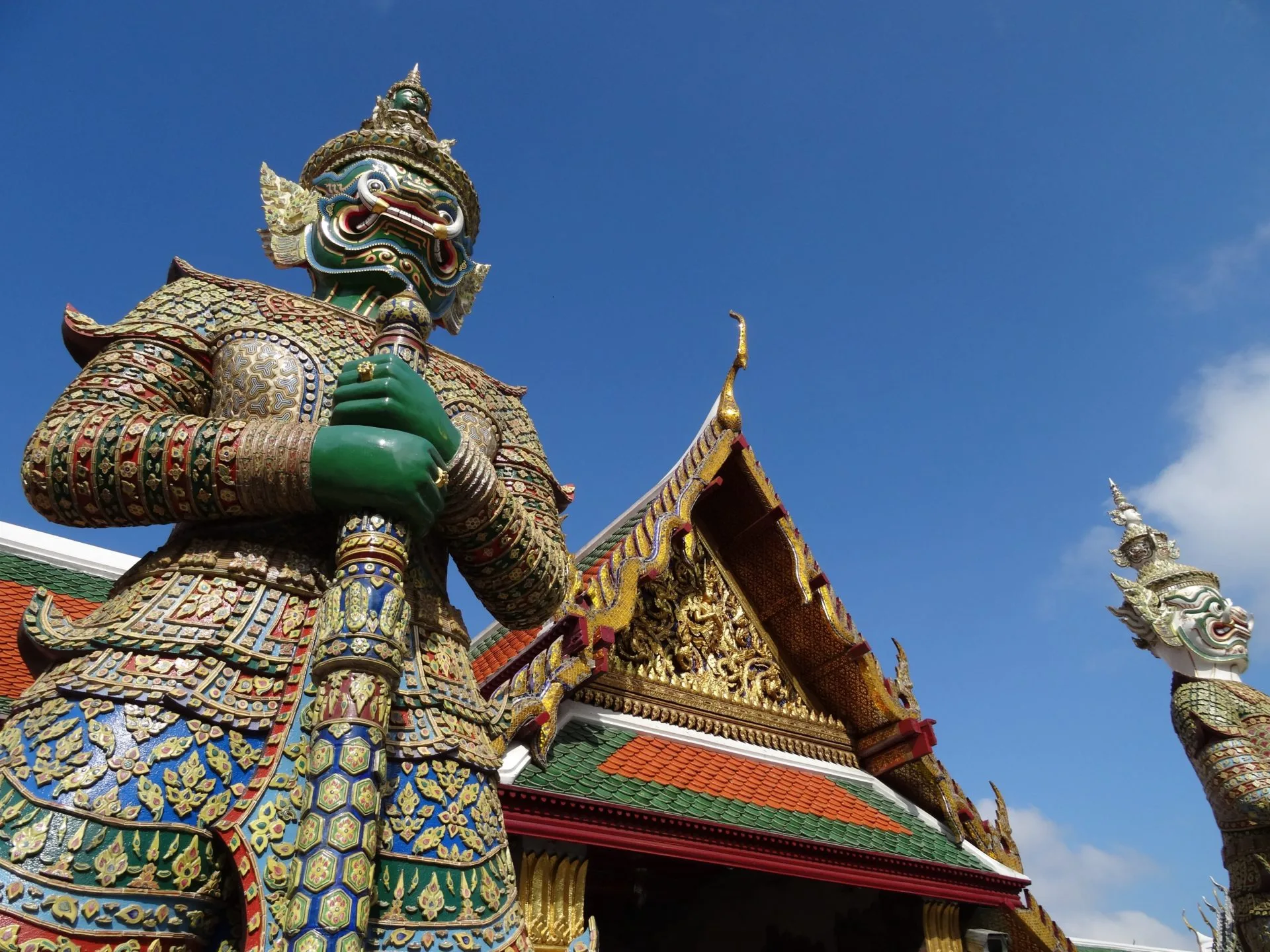
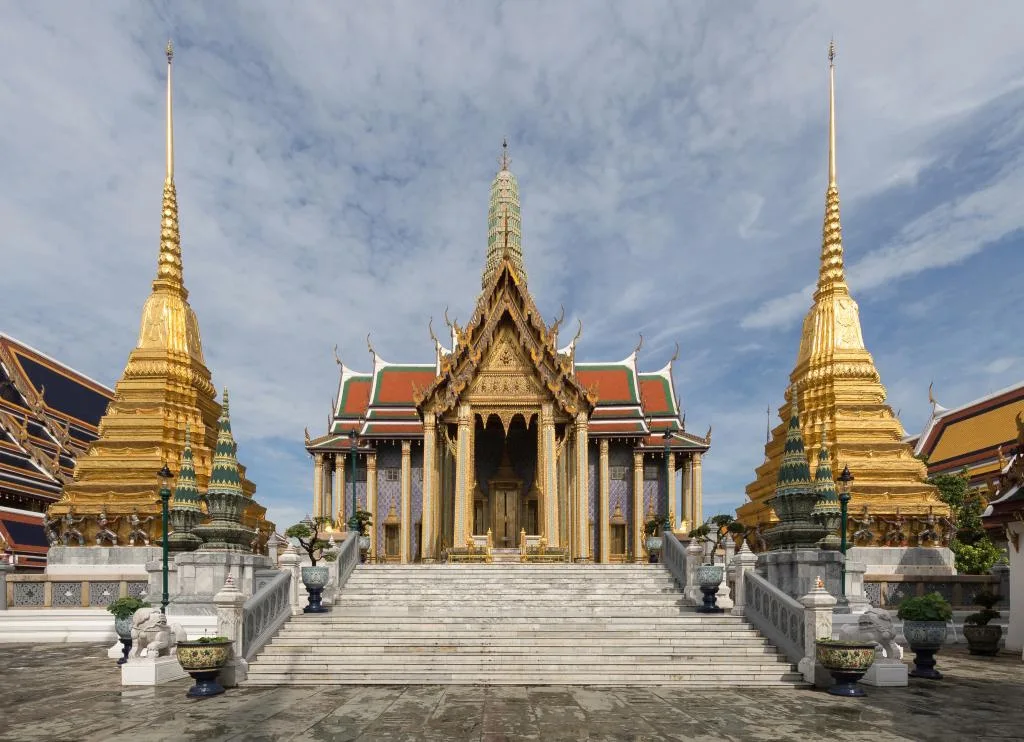
At Wat Phra Kaew, a green-faced yaksha guardian, resting on his club and clad in porcelain and glass mosaic, stands before a gilded gable with green and orange tiled roofs; a second, white-faced guardian appears on the right.© Internet 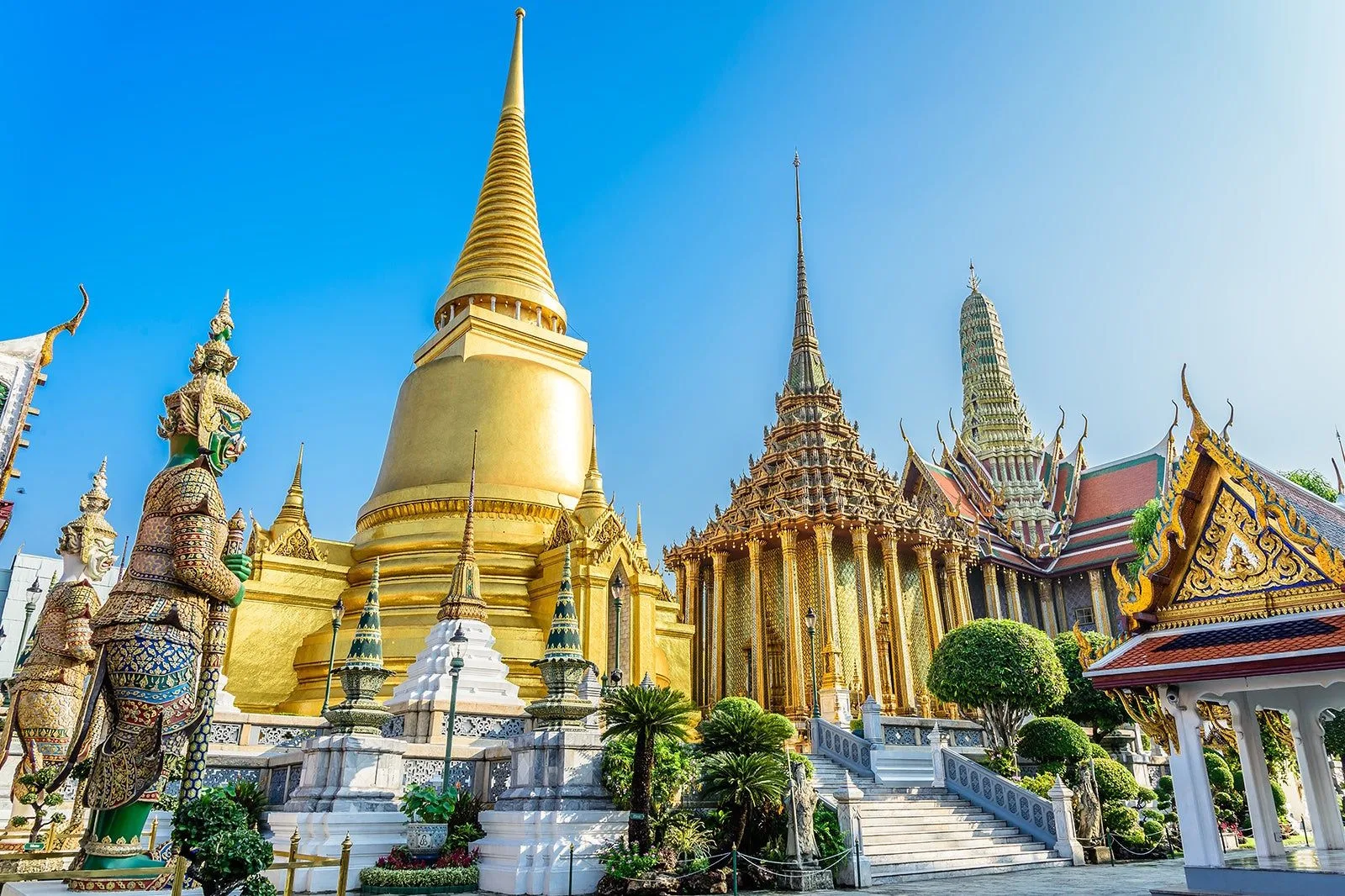
At Wat Phra Kaew, a large golden chedi stands beside a mondop with ornate columns and a building crowned by a prang, watched over by yaksha statues; clipped shrubs line the stairways and terraces.© Internet
Architecture and decoration
Explore the heritage
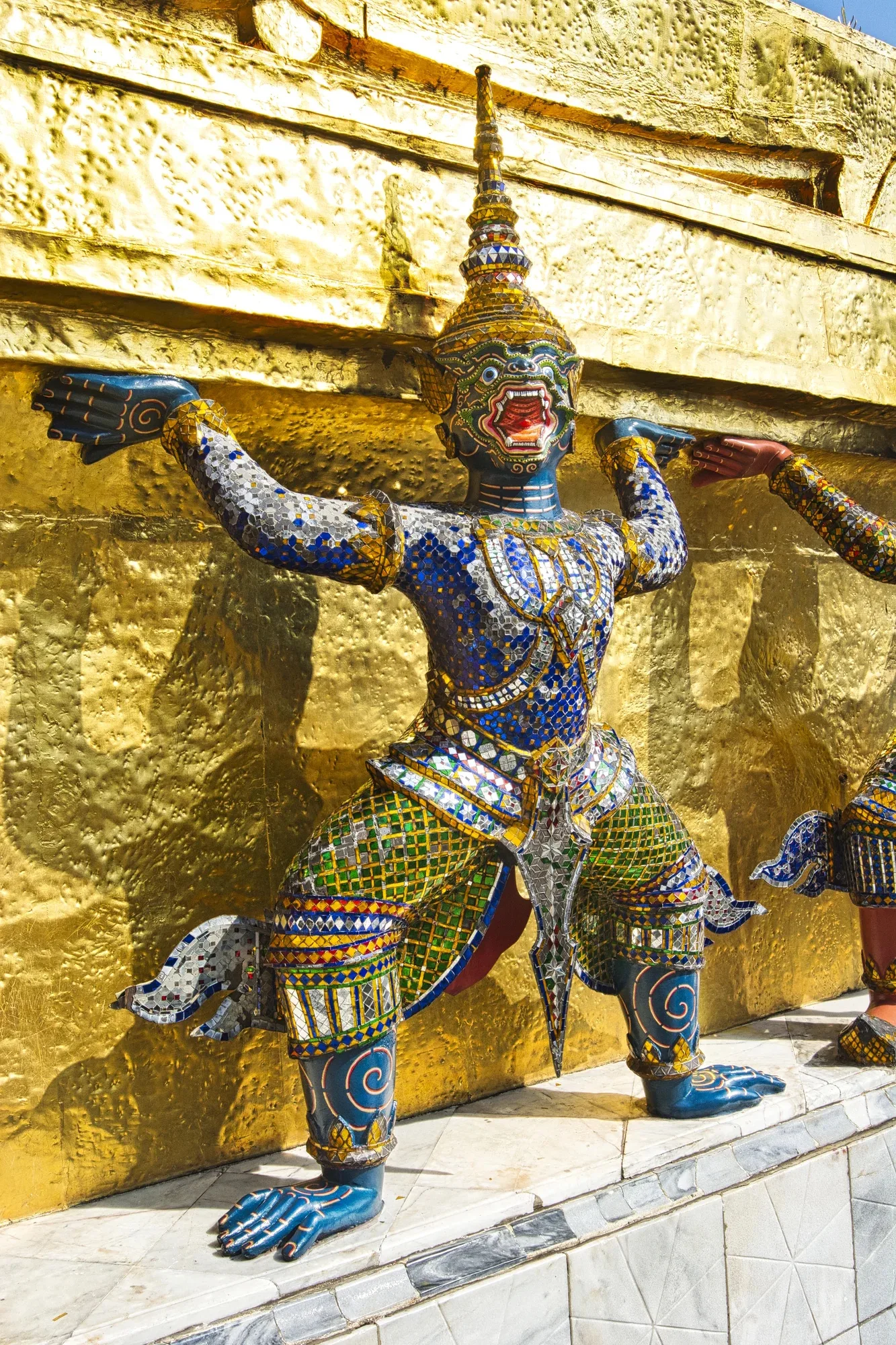
At Wat Phra Kaew, a yaksha figure wearing a tall crown and clad in blue, silver and green glass mosaic appears to bear the gilded base of a chedi, beside another similar figure.© Internet 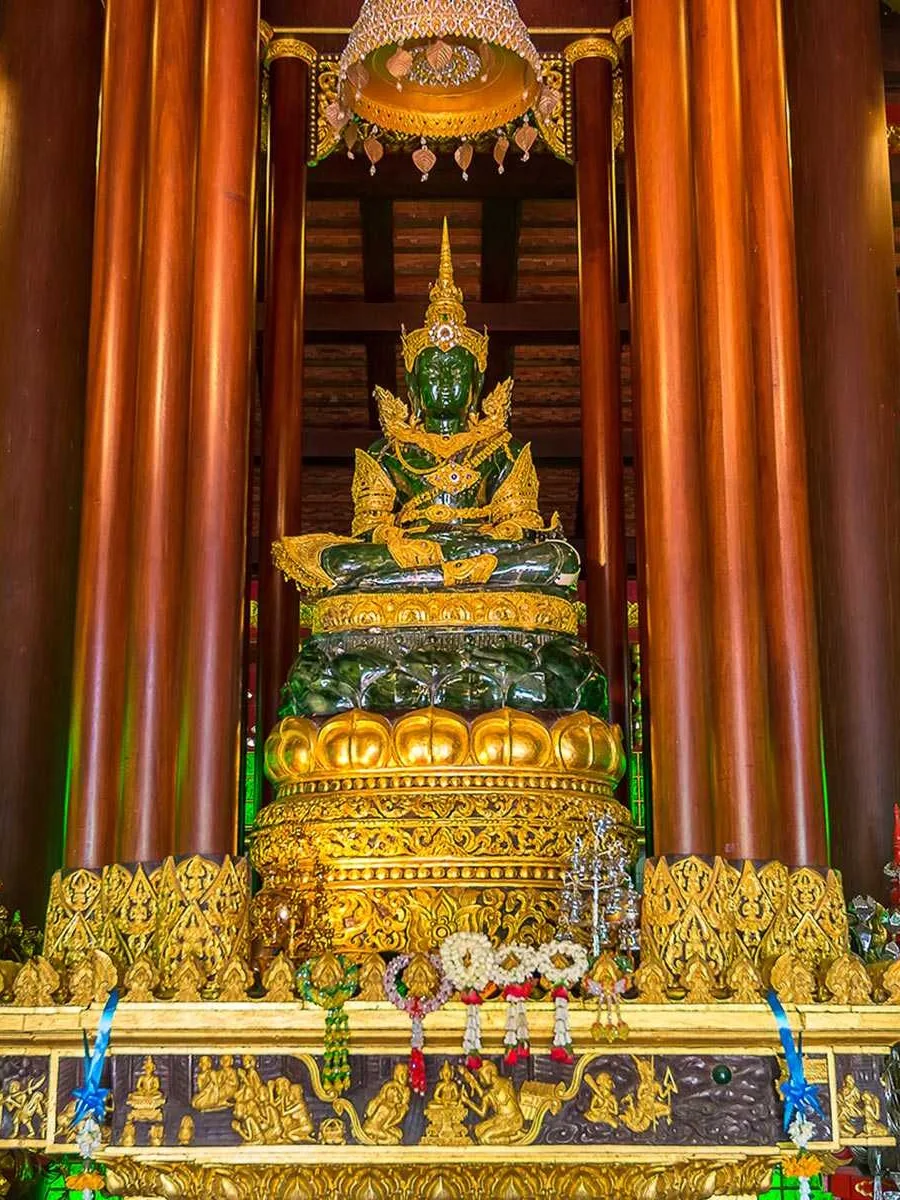
At Wat Phra Kaew, a green Buddha statue, seated in meditation and adorned with a gilded headdress and ornaments, rests on a tall gilded lotus-shaped base. Jasmine garlands, a carved gilded frieze and red columns frame it.© Internet
Archive
Memory of time passing
Historical images preserve the visual memory of places and of the ways they have changed.
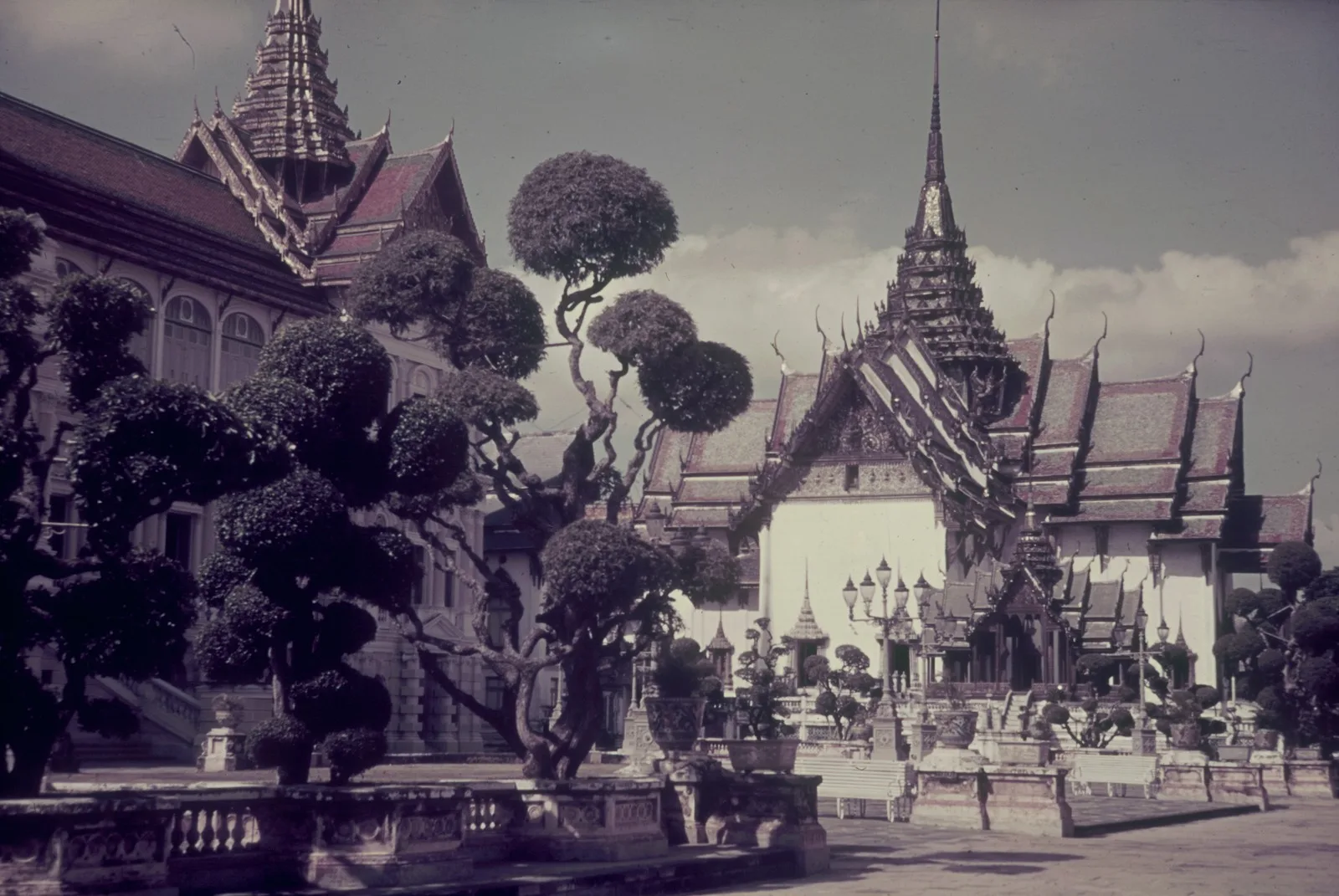
Old slide with faded colours, associated with Wat Phra Kaew: topiary trees and balustrades line a paved courtyard before a white pavilion with tiered roofs and a gilded spire and a European-style building crowned with Thai roofs.Grasser, Franz — Deutsche Fotothek (Europeana), domaine public 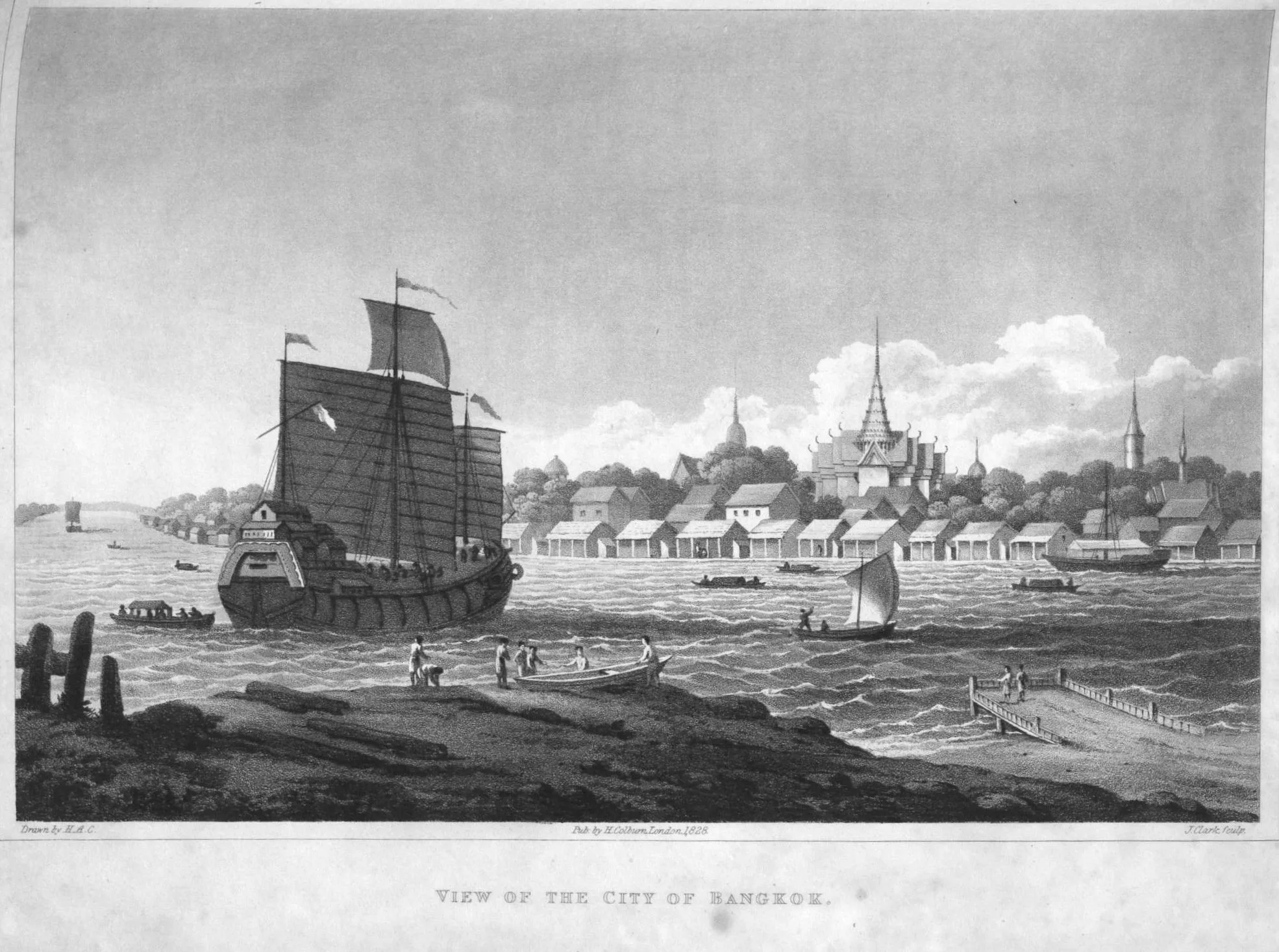
Black-and-white engraving entitled ‘View of the City of Bangkok’: a junk and small boats ply the river before a row of houses on the water, overlooked by the tiered roofs and spires of Wat Phra Kaew.John Crawfurd — Wikimedia Commons, domaine public 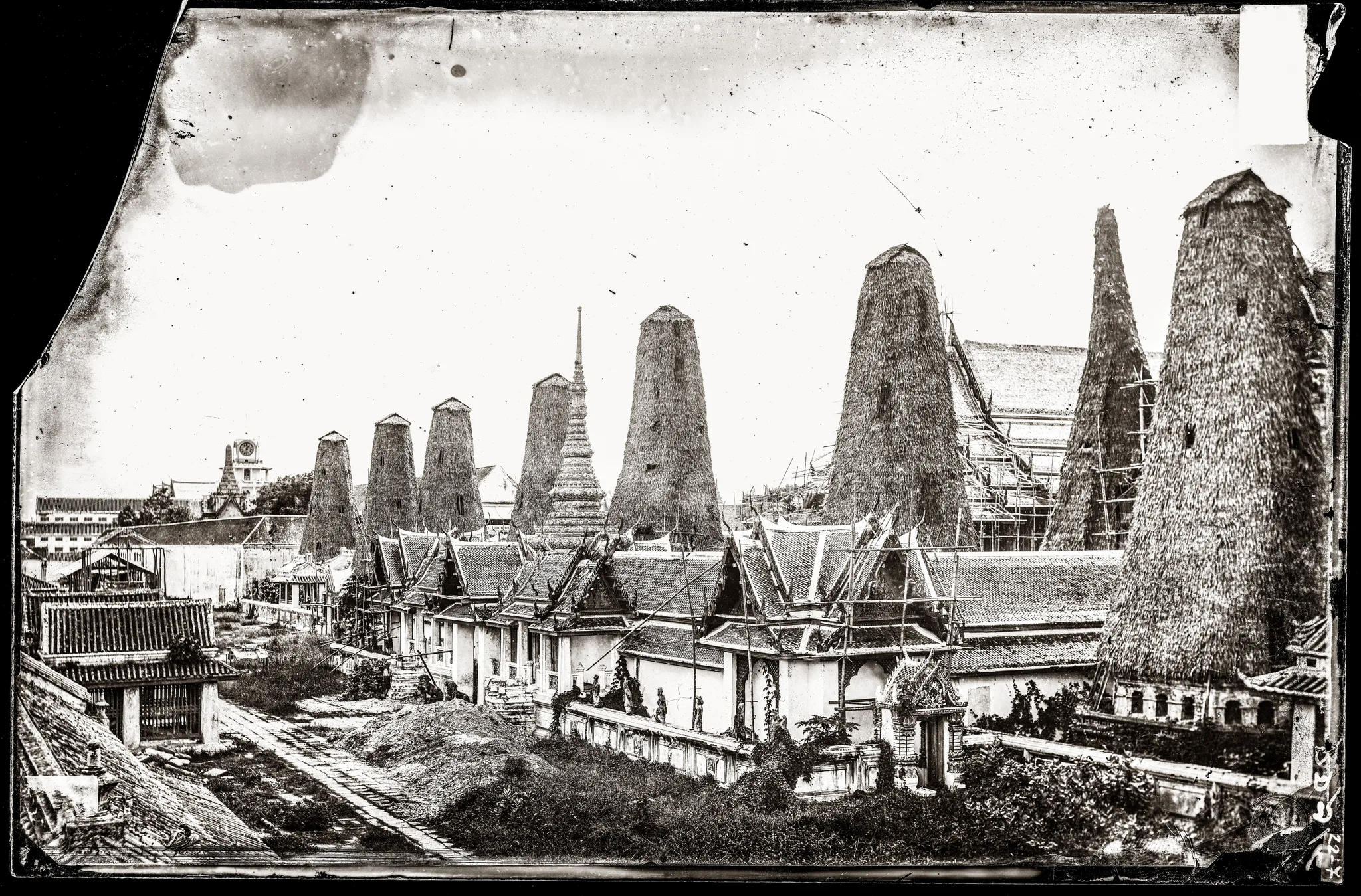
Old photograph of Wat Phra Kaew: several spires, wrapped in tall plant-material cones and scaffolding, rise above galleries with tiered roofs. A slender chedi remains uncovered in the centre, with a clock tower in the background.Auteur inconnu — Wikimedia Commons, domaine public 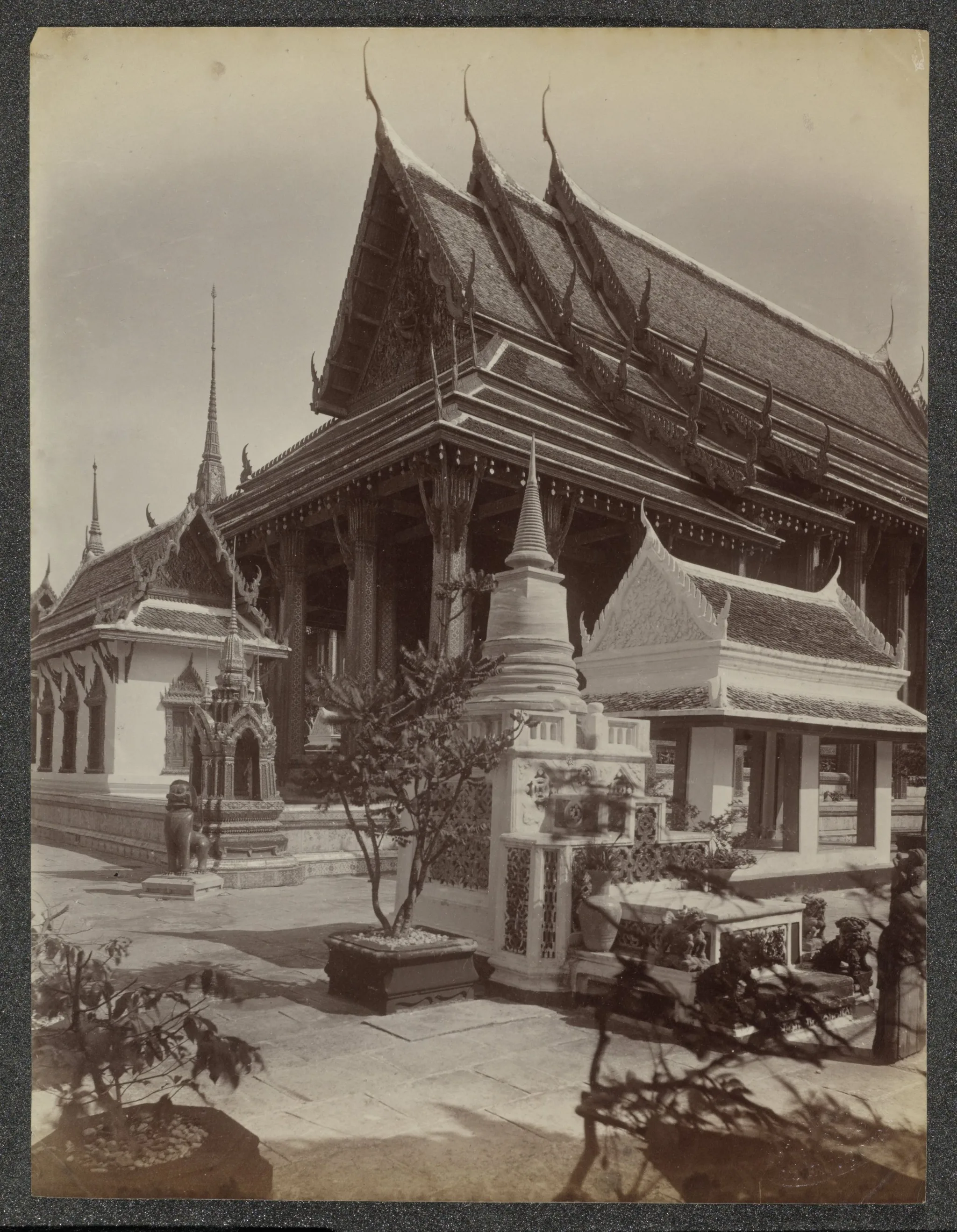
Early print showing the main building of Wat Phra Kaew, with superimposed roofs adorned with chofa and carried on decorated pillars, surrounded by a small white chedi, pavilions, a guardian lion and potted shrubs.Rijksmuseum — Wikimedia Commons, CC0 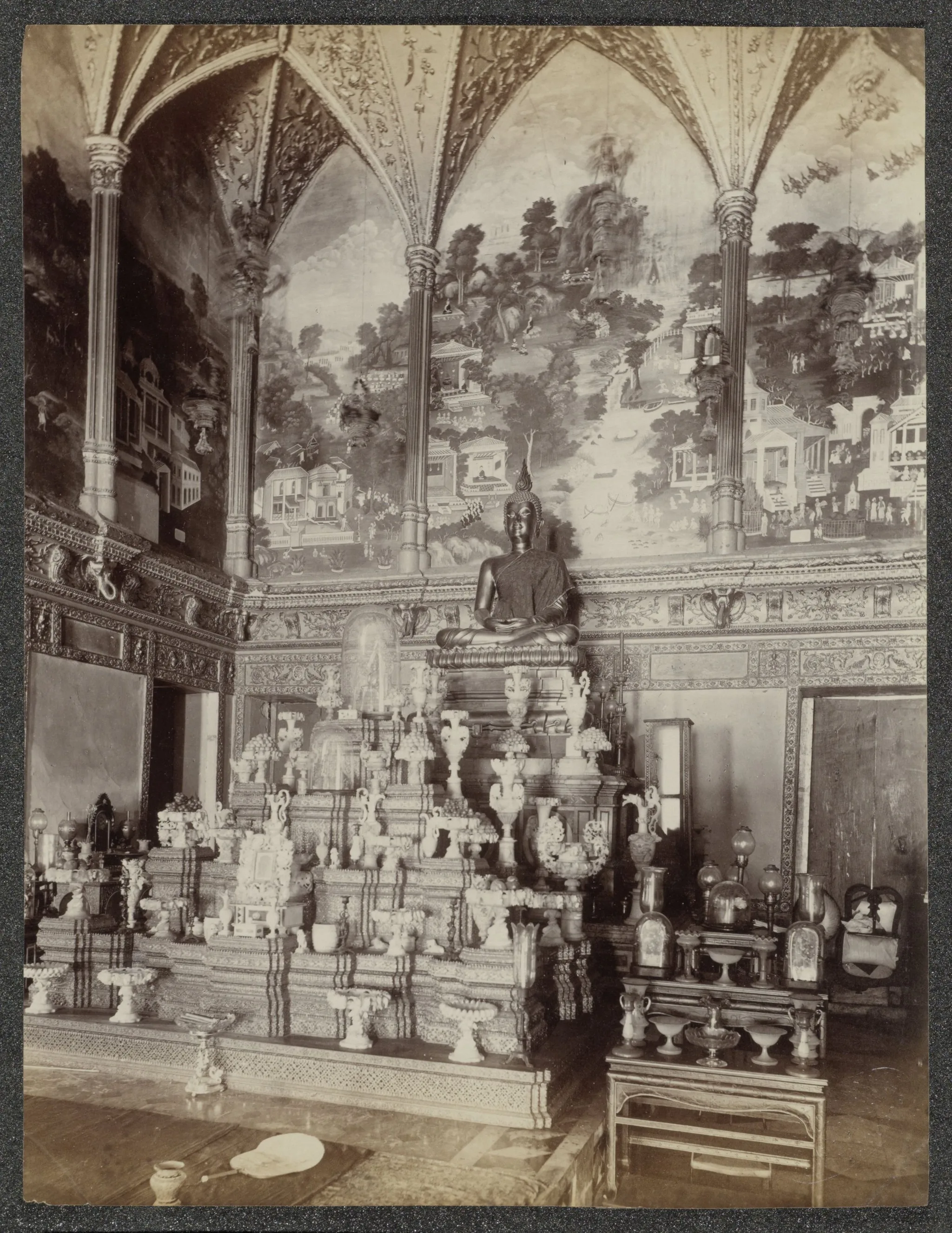
Interior of Wat Phra Kaew: a Buddha seated in meditation presides over a tiered altar laden with vases, lamps and objects under glass domes. Above, mural paintings of landscapes and pavilions extend beneath ornate vaults.Rijksmuseum — Wikimedia Commons, CC0 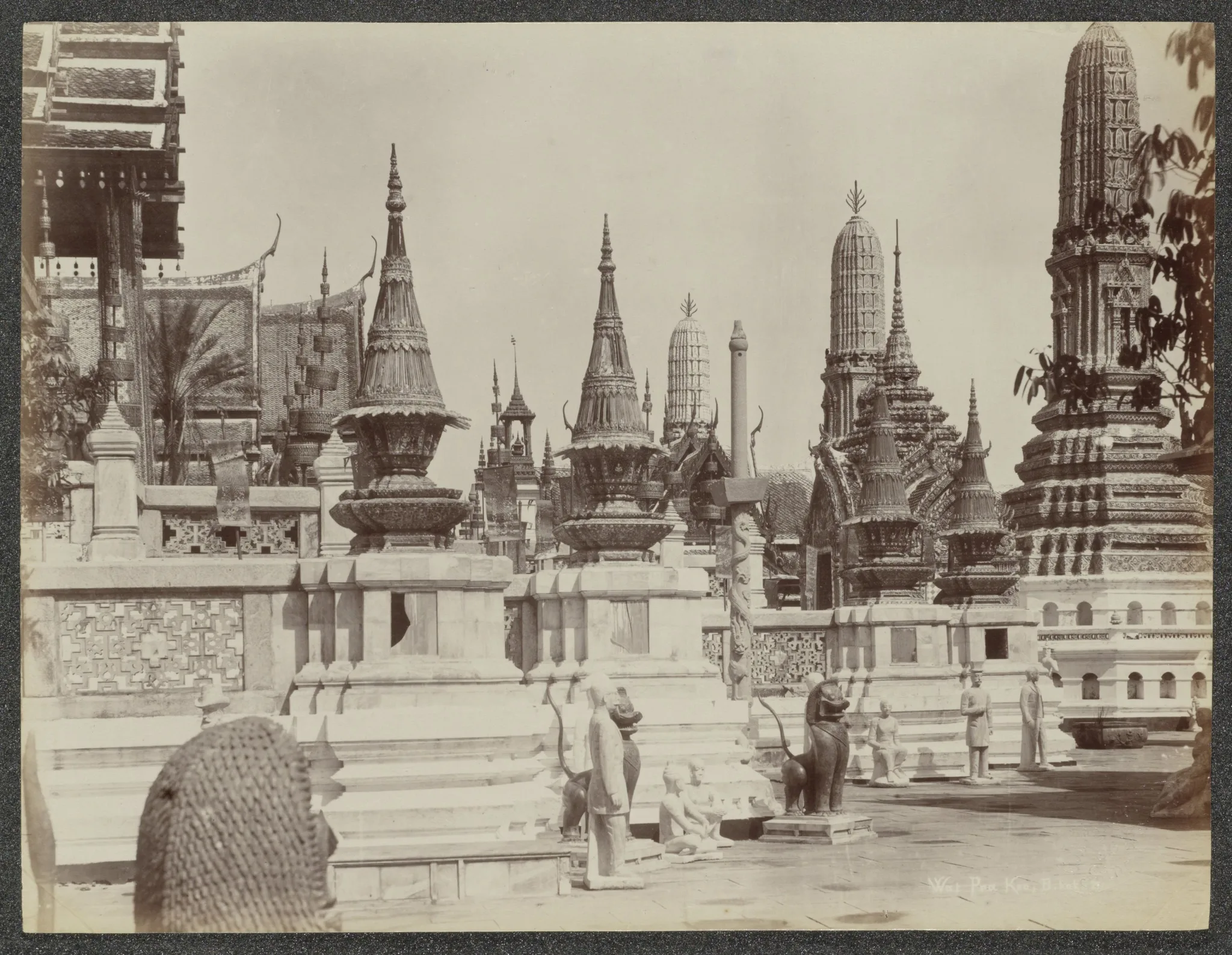
Antique print showing a paved terrace at Wat Phra Kaew: stone statues and guardian lions before plinths with pierced balustrades, ornate spires, decorated prangs and layered gabled roofs.Rijksmuseum — Wikimedia Commons, CC0 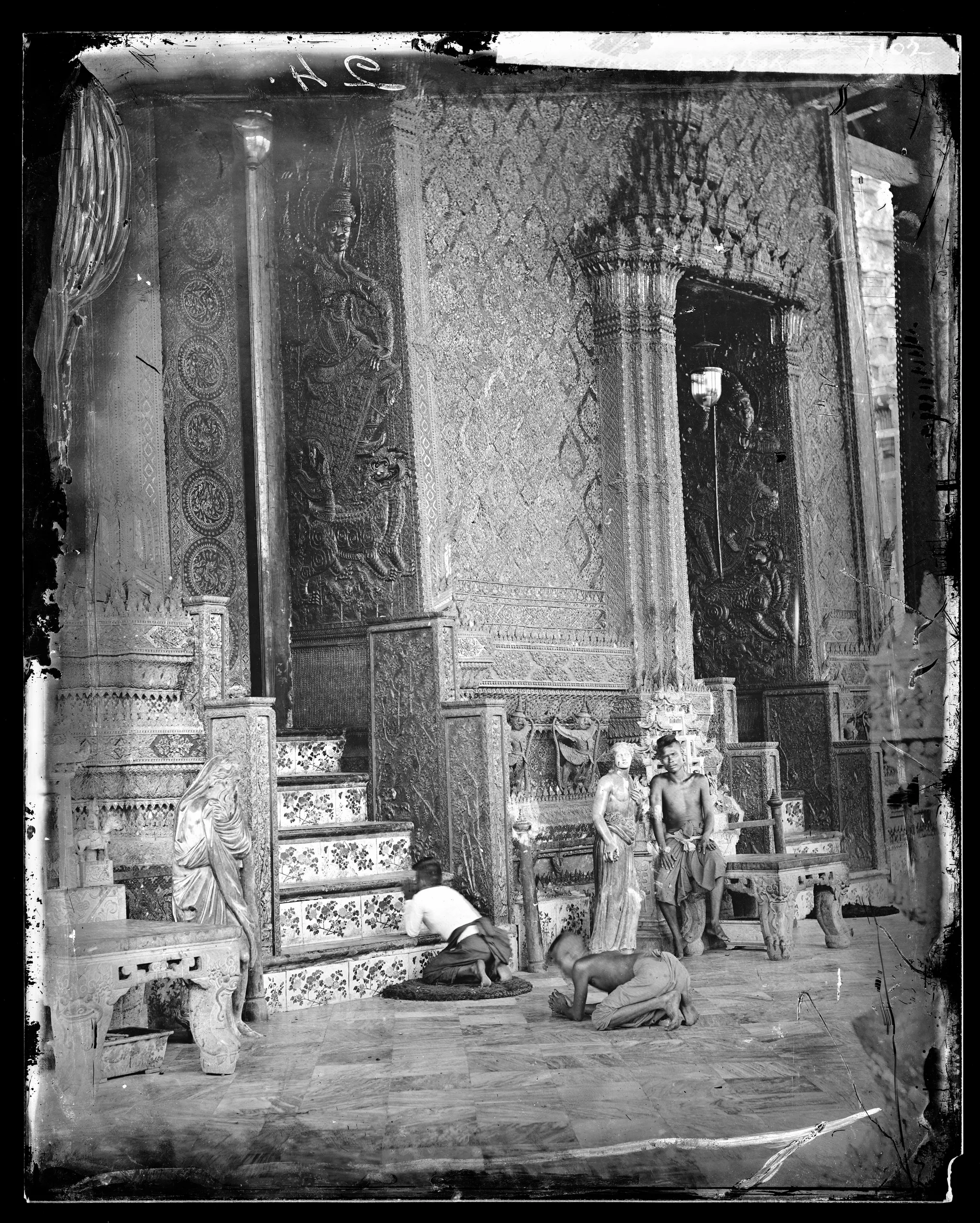
Entrance to Wat Phra Kaew: door leaves carved with guardian figures, walls with lozenge decoration, steps faced with floral-patterned tiles and stone statues; three men are present, two of them kneeling.Auteur inconnu — Wikimedia Commons, CC BY 4.0 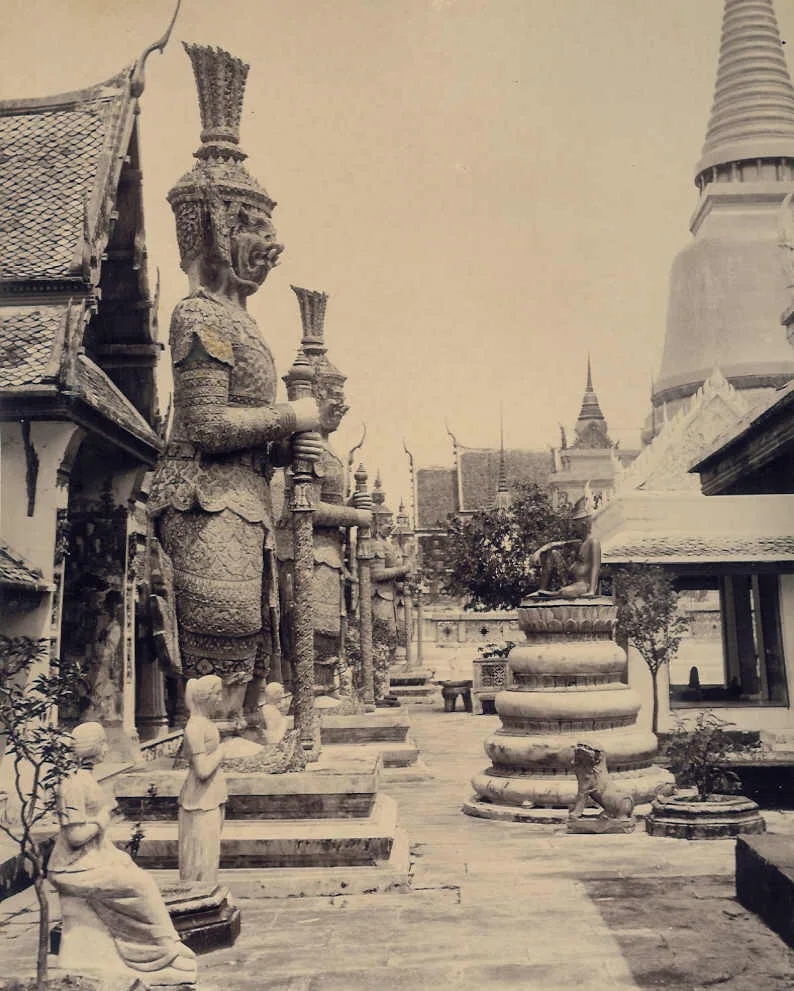
In a paved courtyard of Wat Phra Kaew, a line of giant guardians wearing tall crowns leans on clubs above small stone statues; on the right stand a bell-shaped chedi and a seated Buddha on a lotus pedestal.Khun Sunthornsathitsalak (also known as Francis Chit) 1830 Bangkok, Thailand – 1891 — Wikimedia Commons, domaine public 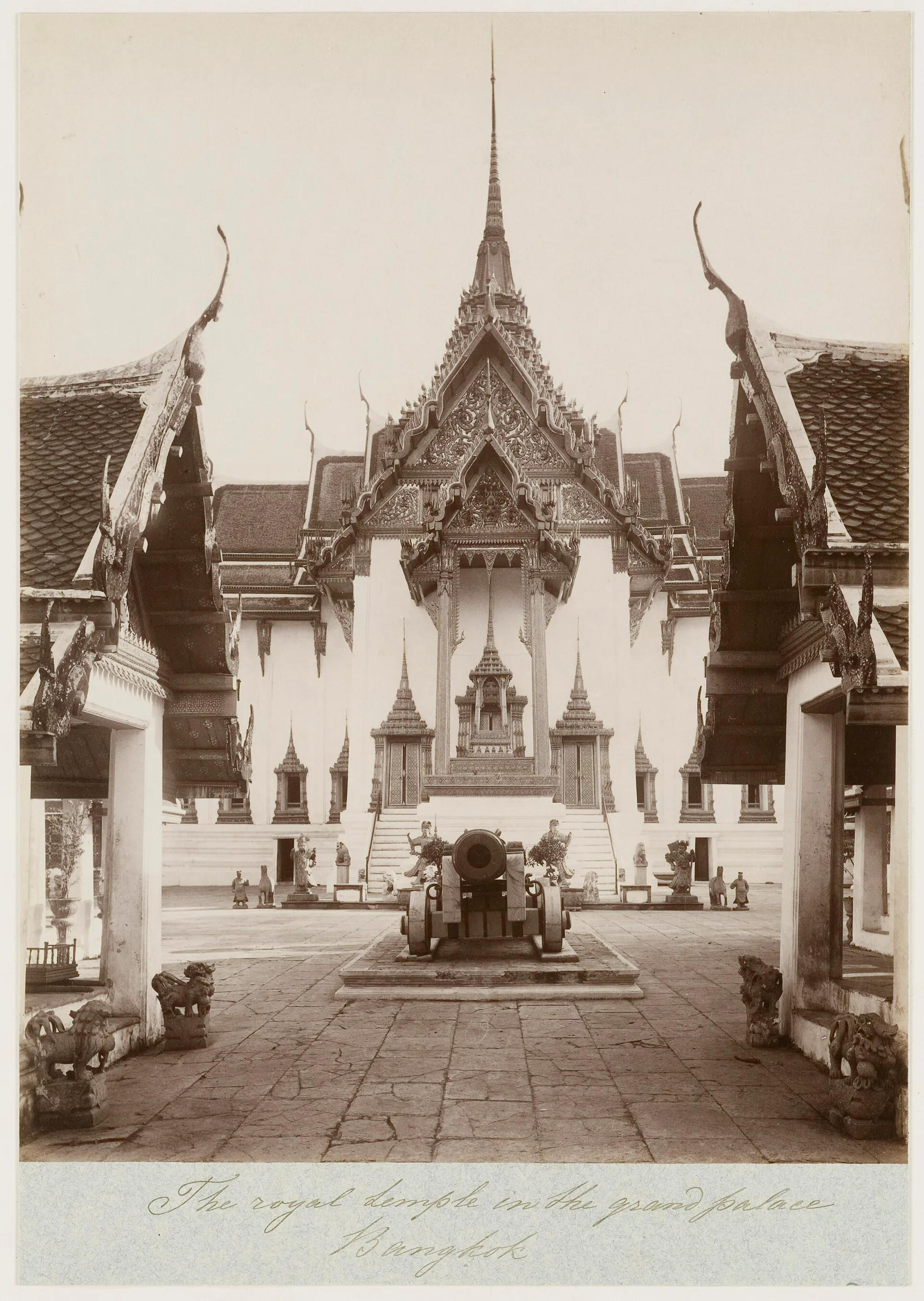
At Wat Phra Kaew, between two tiled gate pavilions, a paved courtyard leads to a white spired building whose porch shelters a pinnacled pavilion; a cannon, stone statues and guardian lions punctuate the space.Lambert & Co., G.R. / Singapore — Wikimedia Commons, domaine public 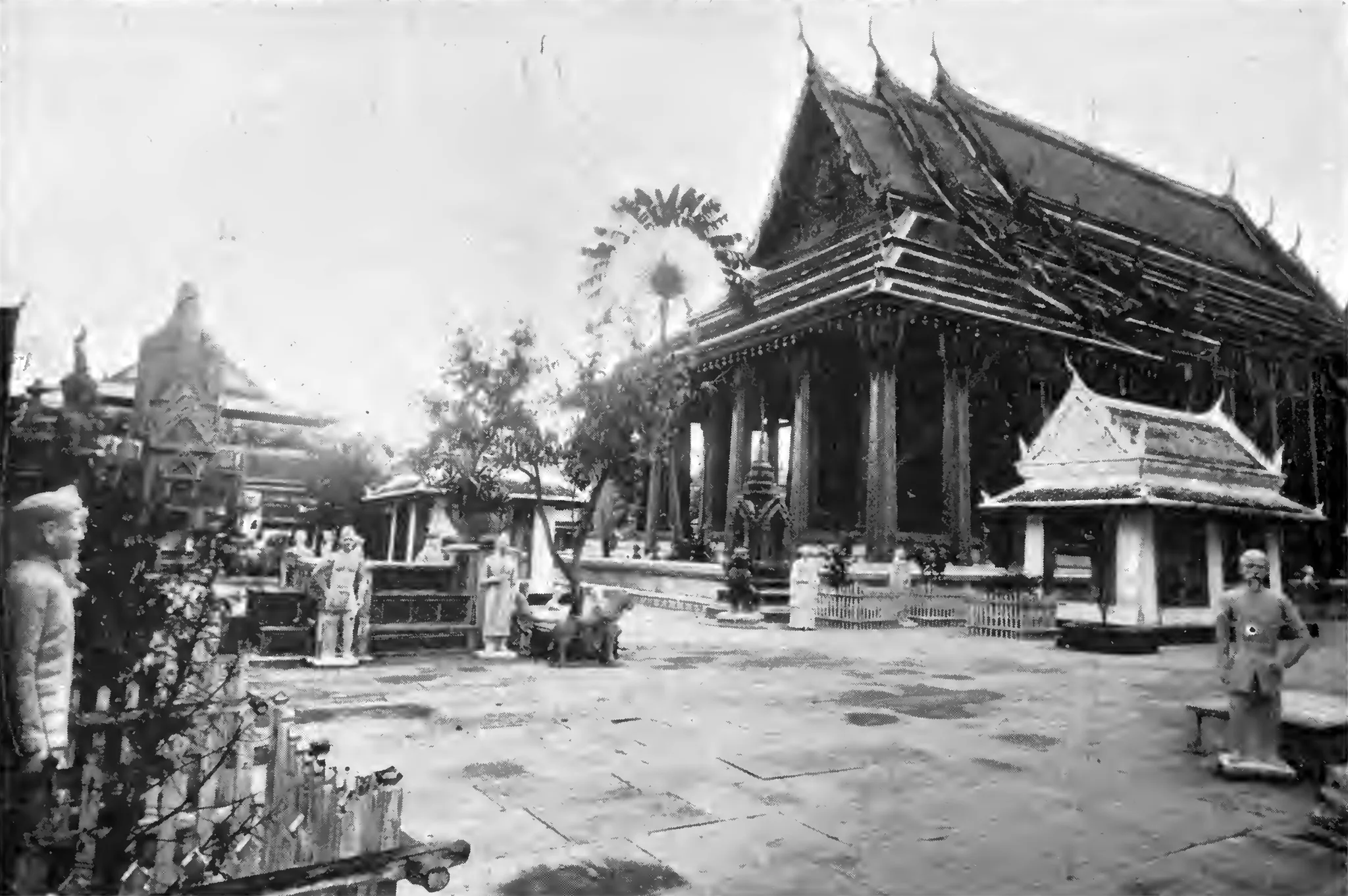
Old view of the courtyard of Wat Phra Kaew: the ubosot, with its tiered roofs adorned with chofa and its colonnade, overlooks a paved forecourt where costumed stone statues stand near a small pavilion.Auteur inconnu — Wikimedia Commons, domaine public 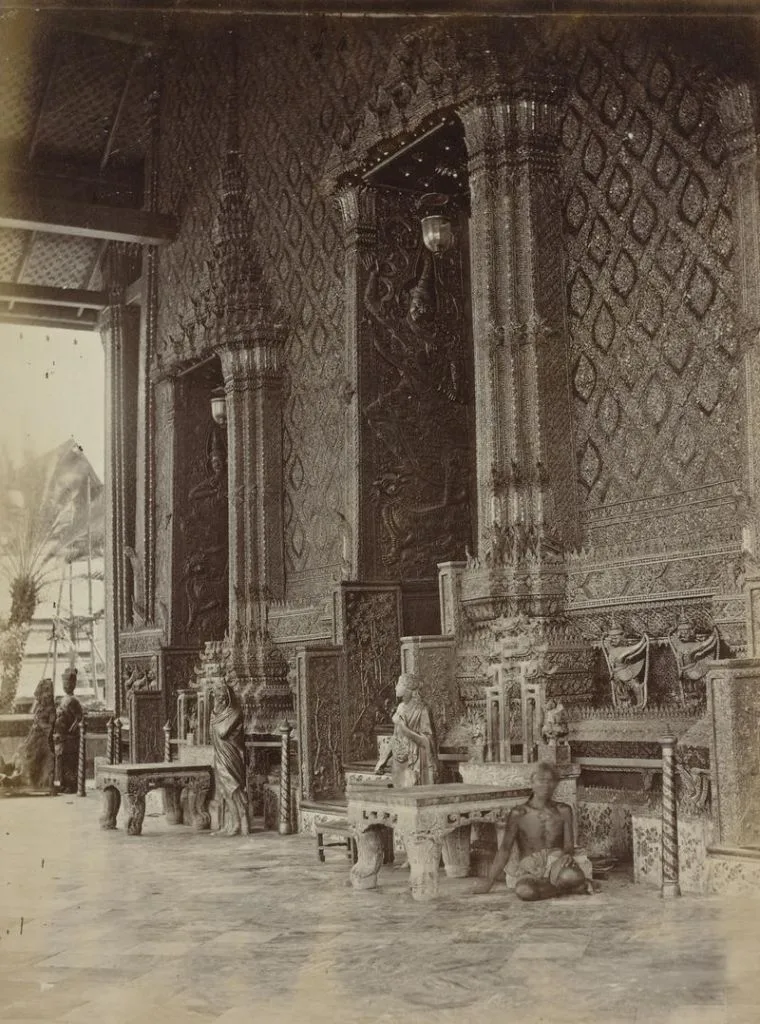
Old photograph of the gallery of Wat Phra Kaew: walls covered in lozenge-patterned decoration, doorways framed by ornate pilasters, door panels carved with guardian figures, stone statues, low tables and a man seated on the paving.Auteur inconnu — Wikimedia Commons, domaine public 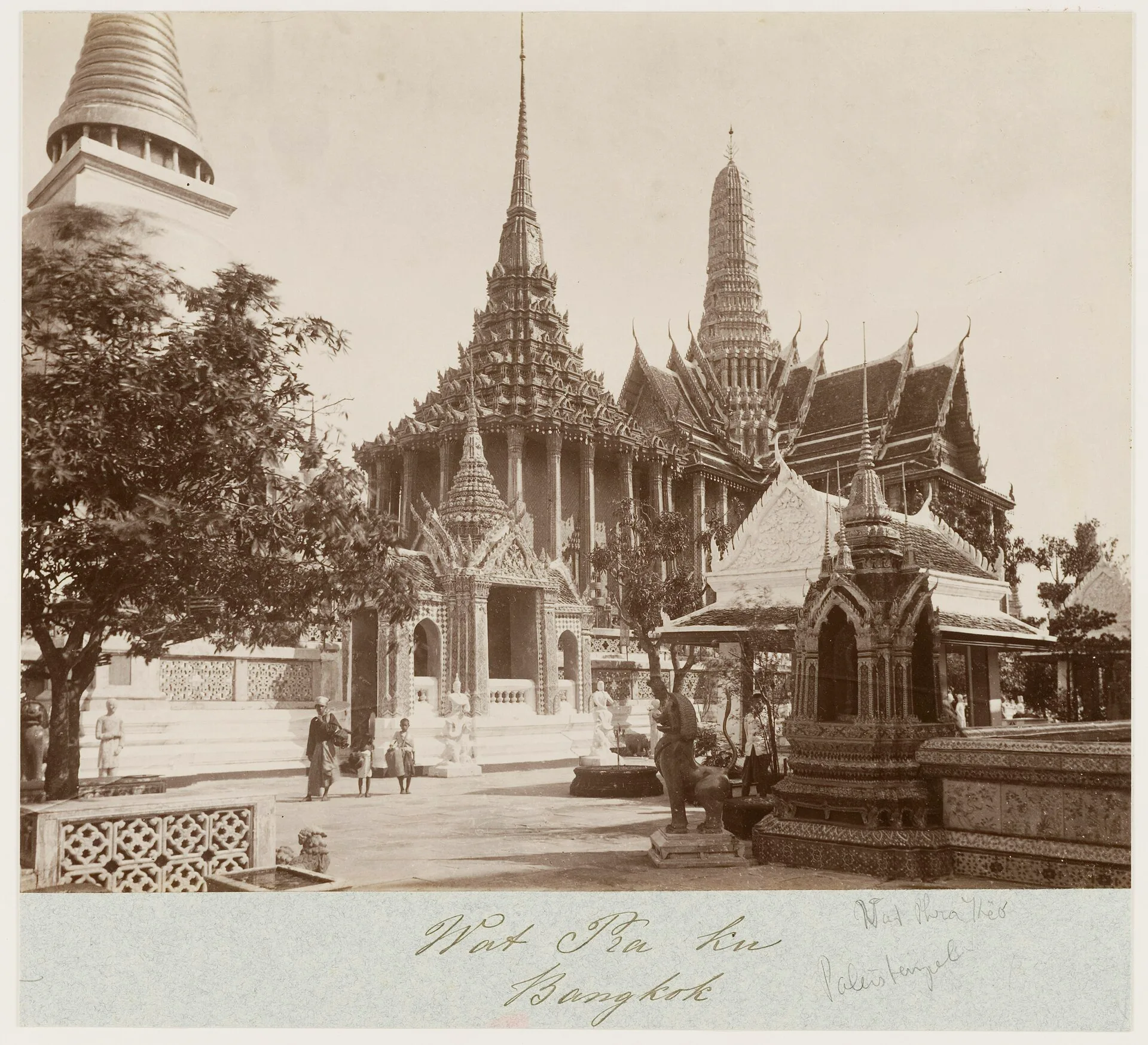
Early photograph of Wat Phra Kaew: beyond a paved courtyard stand a mondop with a slender spire, the chofa-tipped roofs of a sanctuary and a prang; a chedi, statues and pierced balustrades frame the scene.Lambert & Co., G.R. / Singapore — Wikimedia Commons, domaine public 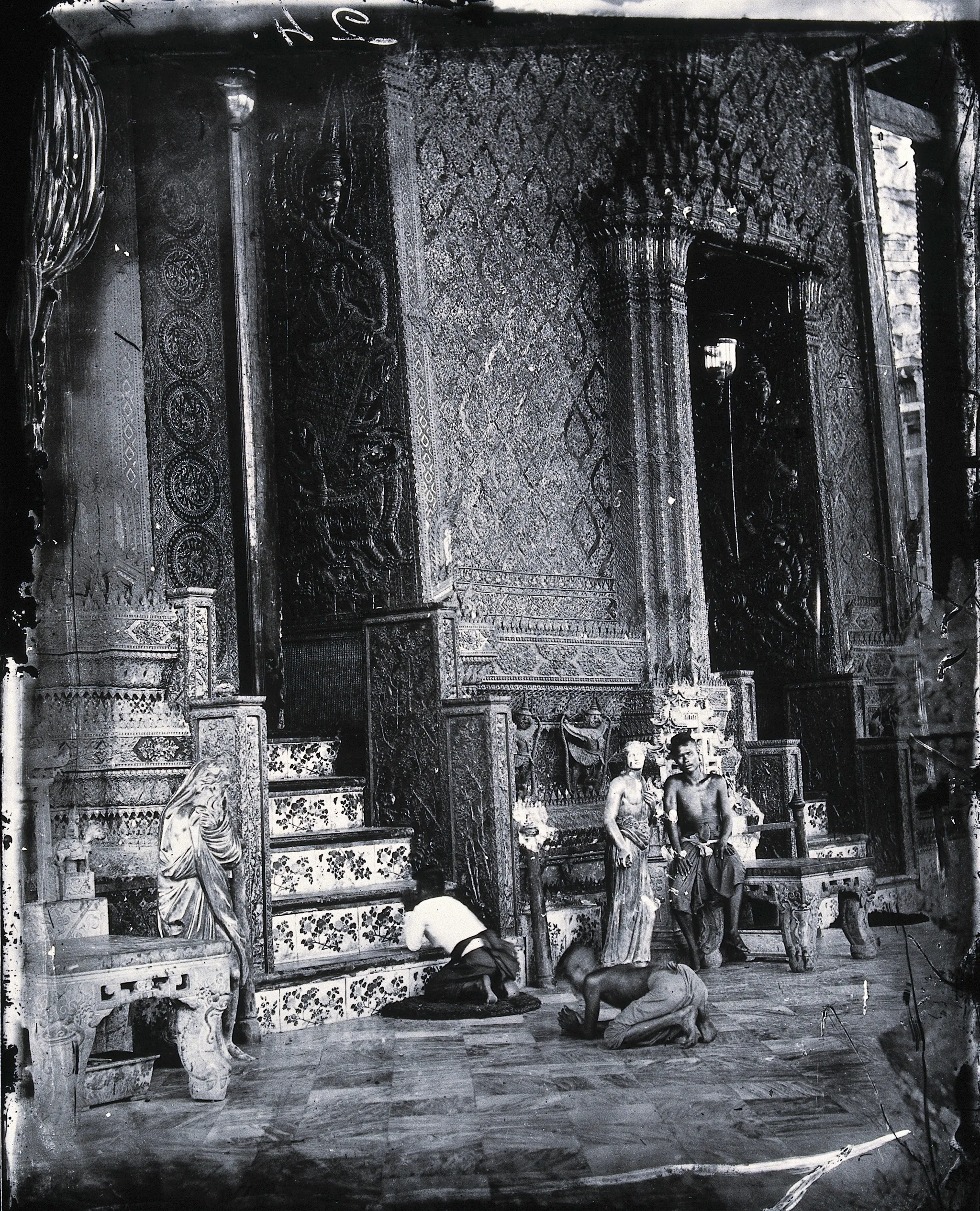
Old photograph of an entrance at Wat Phra Kaew: walls inlaid with patterns, a doorway framed by an elaborate pediment, steps faced with floral tiles and Western-style statues, before which two men prostrate themselves.Auteur inconnu — Wikimedia Commons, CC BY 4.0 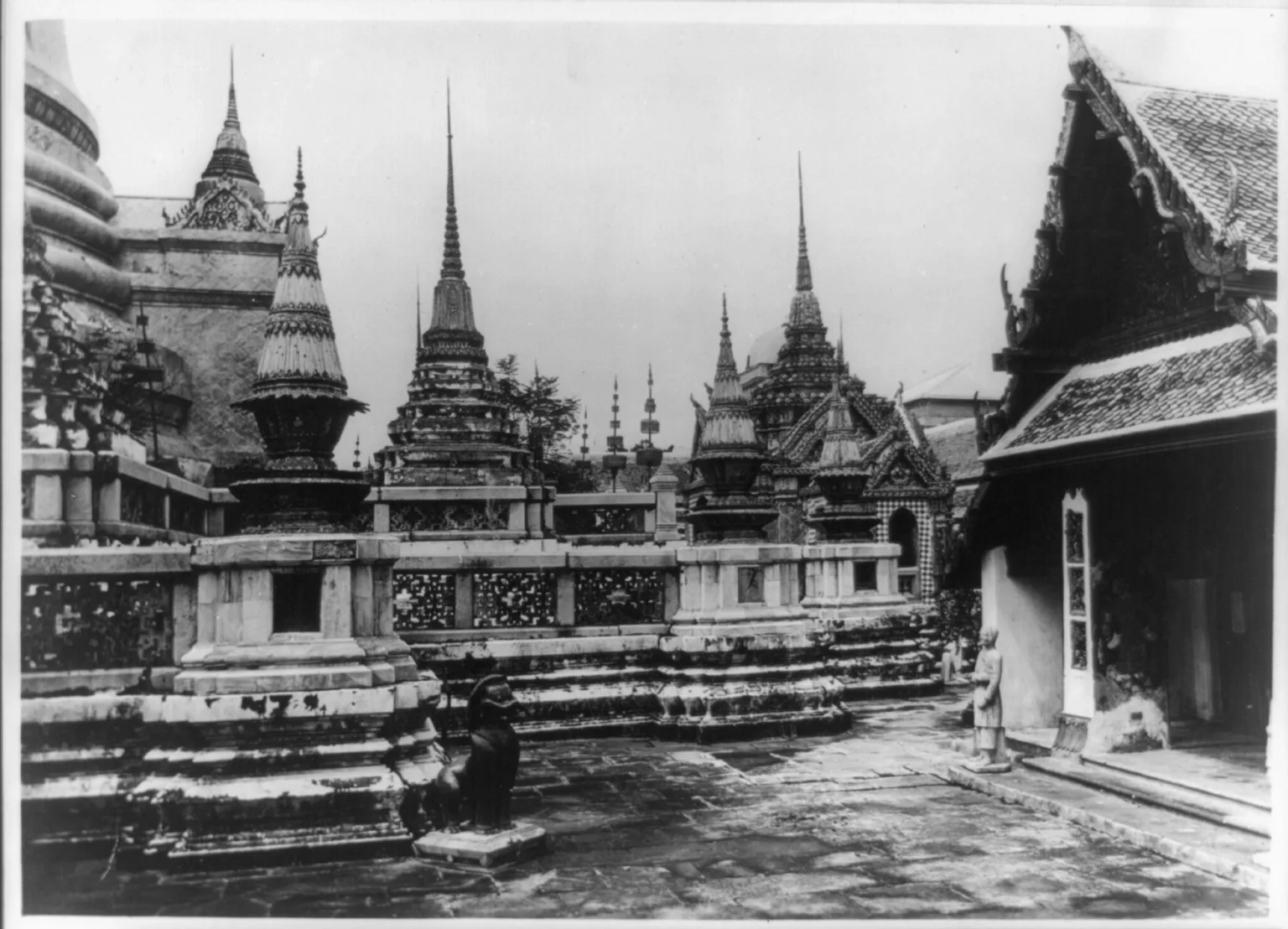
Early photograph of Wat Phra Kaew: tapering spires and ornate pavilions rise above a paved terrace edged with pierced balustrades; a guardian statue stands beside the decorated gabled building on the right.Frank and Frances Carpenter Collection — Wikimedia Commons, domaine public 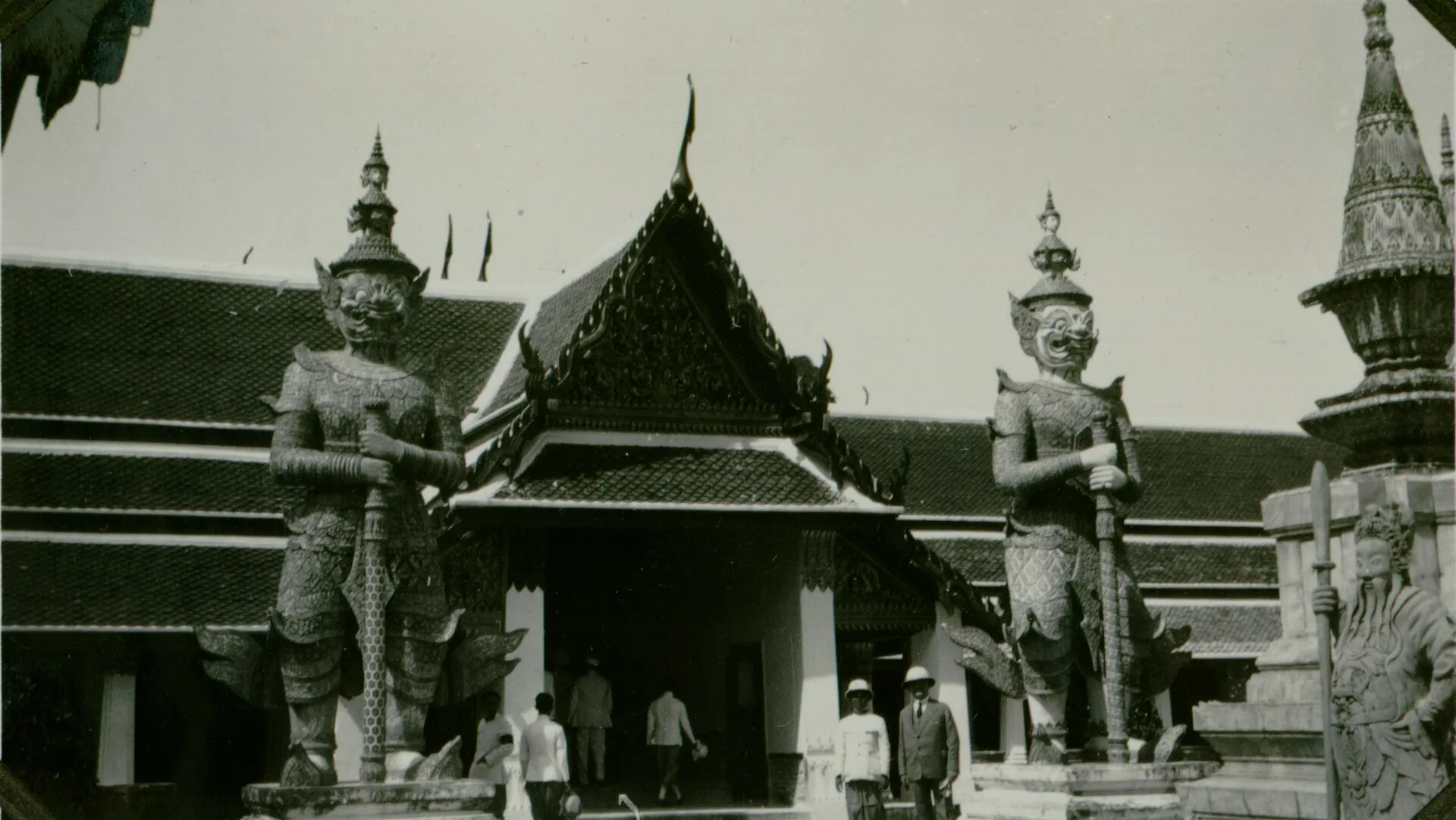
At Wat Phra Kaew, two yaksha giants holding clubs flank a gateway topped by a carved gable, before the tiered roofs of the gallery; on the right stand a Chinese-style guardian statue and an ornate chedi, with visitors in suits.Auteur inconnu — Wikimedia Commons, CC BY 4.0 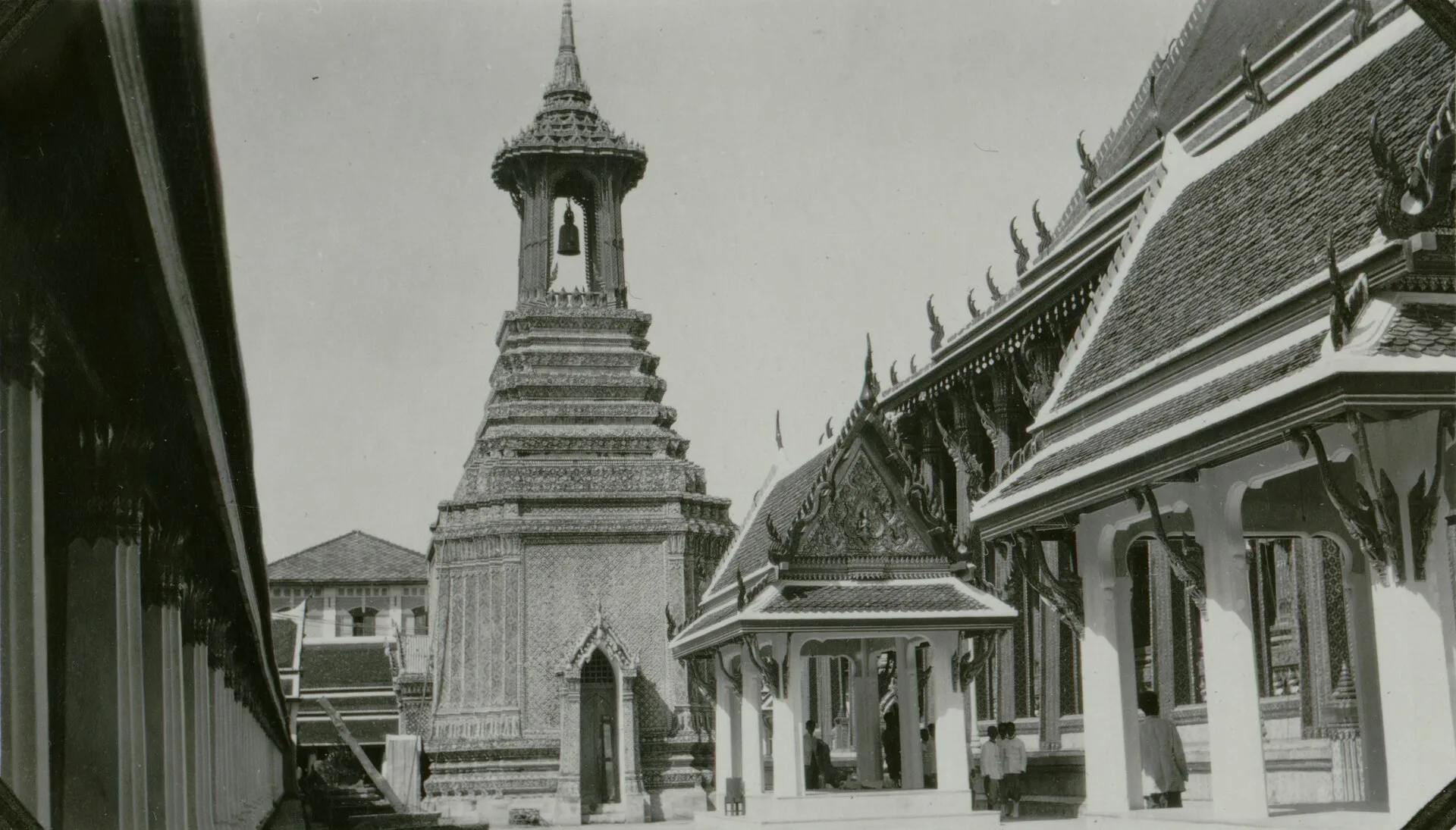
At Wat Phra Kaew, a bell tower with a richly decorated tiered base holds a bell beneath a slender spire; to the right stand an open pavilion and a building with gabled roofs adorned with chofa, facing a long pillared gallery.Auteur inconnu — Wikimedia Commons, CC BY 4.0 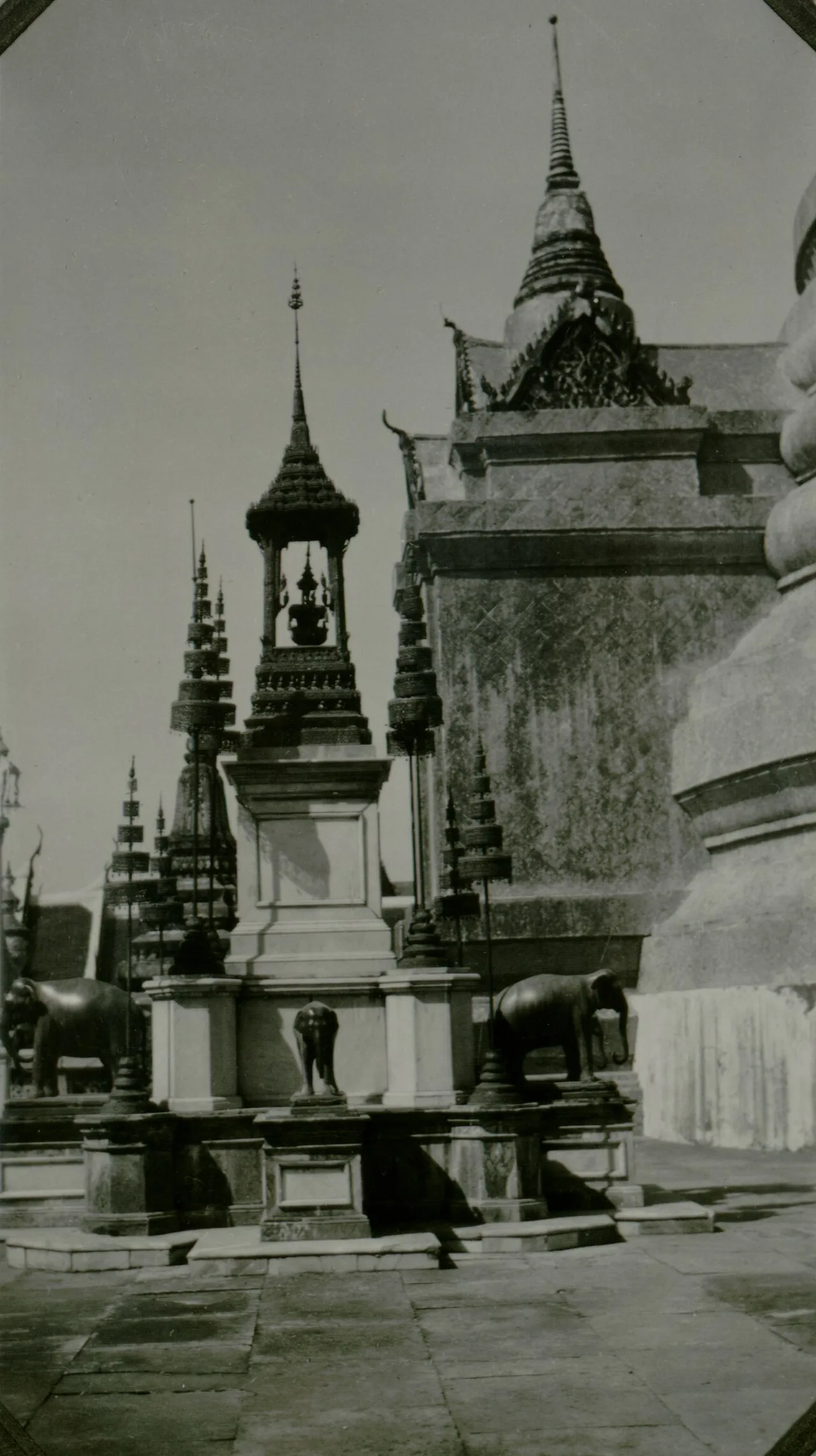
At Wat Phra Kaew, an open pavilion crowned by a spire stands on a tall pedestal, framed by tiered parasols and elephant statues; on the right are the base of a chedi and a building with a pointed roof.Auteur inconnu — Wikimedia Commons, CC BY 4.0